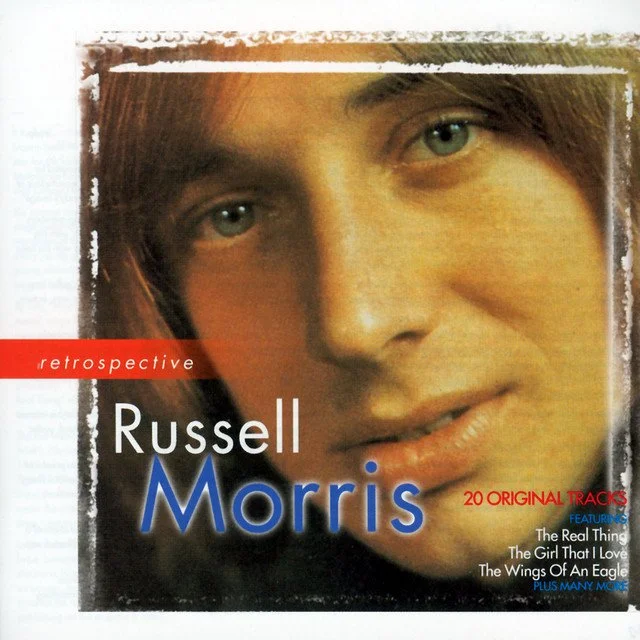
5&5: The Real Thing
We’re back for the final sitting week of the year. A lot happened including the passing of major reforms from online safety, to a gas reservation and tax fairness.
Here’s the 5&5:
BEST
Digital duty of care passes the Parliament
Cheaper medicines until the end of the decade
Gas reservation passes Parliament
Stronger ties with Solomon Islands
Australia’s place in the world
WORST
Voting against fairness
Another one bites the dust
The ghosts of Liberal leaders
Own goal
Thank you for your rhetoric

1. Digital duty of care passes the Parliament
The principle of the Digital Duty of Care is simple: it's your social media feed, and you shouldn't be powerless over what appears in it. On Wednesday, Parliament passed the legislation, taking a major step towards making online platforms take responsibility for the safety of Australians using their services. Anika Wells, who has done a phenomenal job leading this reform, had these words during Question Time later that day: “A Digital Duty of Care provides an opportunity to shift responsibility towards prevention, towards safer design, and to demonstrable accountability.”
2. Cheaper medicines until the end of the decade
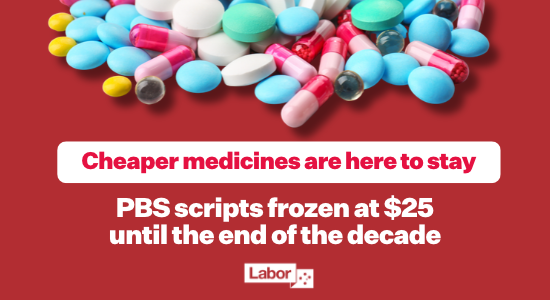
Cost-of-living relief doesn't get much more practical than this. This week the Prime Minister and Mark Butler announced that Labor is locking in the maximum cost of a PBS script at $25 until the end of the decade. This has already helped Australians save $3.3 billion, while more than 500 new and amended medicines have been added to the PBS. Mark Butler told QT on Monday: “For the first time in the PBS's history of almost eight decades, the script price actually went down. It's now $25 a script for general patients, no more than that, less than half the $50 it would have been if we'd not taken action.”
3. Gas reservation passes Parliament
On Friday morning, the Parliament passed landmark legislation to implement a Domestic Gas Reservation, securing cheaper gas for Australians. As Madeleine King told the House, Australian gas should work for Australians: “This Labor government under this Prime Minister, has taken on the challenge that governments before us have not to regulate Australia's export markets so that gas exporters provide just some of that gas for Australians. It is a simple proposition and what should have been done years ago is being delivered by this government for the Australian people today.”
4. Stronger ties with Solomon Islands
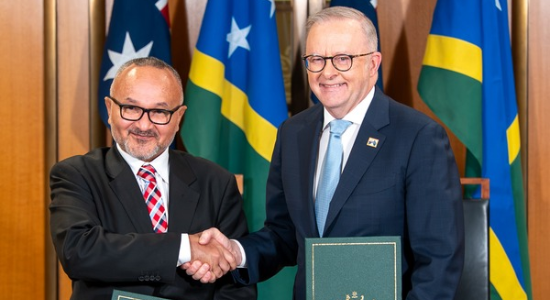
Our Pacific neighbours are like family, and this week we reaffirmed that bond. On Wednesday, Australia and Solomon Islands signed a landmark treaty that will deepen ties between our two countries for years to come. Visiting Parliament House, Solomon Islands Prime Minister Matthew Wale described the agreement as one that “not only resets our relationship with Australia, but elevates it to an enduring one with trust and certainty”. In response to a question from Kate Thwaites, Pat Conroy said, “Australia's security and prosperity depends upon a Pacific that is safe, stable and prosperous. That's why the Albanese Labor Government is working hard to build relationships with the Pacific family. We turn up, we listen and we act on Pacific priorities. That's exactly what we have done with Solomon Islands.”
5. Australia’s place in the world
Our Parliament hears plenty of speeches, but few explain so clearly how Australia should navigate an increasingly uncertain world. On Tuesday, Penny Wong outlined how the Albanese Government is strengthening Australia's security, rebuilding relationships in our region and responding to challenges like AI and cyber threats. Her message was simple: “The purpose of foreign policy is to advance Australians' security and prosperity. The jobs Australians do. The pay they earn. The cost of energy and essential goods. The markets available to our farmers and exporters. The opportunities we create for the next generation. Foreign policy starts and ends at home. So our economic and our foreign policy must reinforce one another.”
1. Voting against fairness
This year's Budget included major tax reforms designed to help young people get into their own home and ensure all Australians pay their fair share of tax. It means ordinary workers will no longer carry the burden while others used discretionary trusts to reduce their tax. The Coalition decided this basic principle of responsible budget management was not worth backing. After these reforms, led by Jim Chalmers, passed Parliament this week without Coalition support, Jim made this important point during Question Time on Thursday, “Those opposite talk a lot about budget repair and budget responsibility, and then they vote against it in the Senate. They talk a lot about spending restraint, and they make $110 billion in unfunded commitments. By their own logic, inflation and interest rates would be higher on their watch.”
2. Another one bites the dust
On Thursday, we all woke to a truly absurd head-scratcher. Leah Blyth, the former South Australian Liberal president, decided to follow Barnaby Joyce and defect to One Nation. It was awkward to witness how quickly Coalition leaders like Jane Hume distanced themselves from someone who started the week on their frontbench. Talk about the wrong priorities. David Moncrieff put it best before QT started on Thursday. “We've delivered tax cuts for working Australians. We've delivered cheaper medicines with $25 PBS scripts. But the only delivery they seem to be focused on is the delivery of more members and senators to the One Nation party room.”
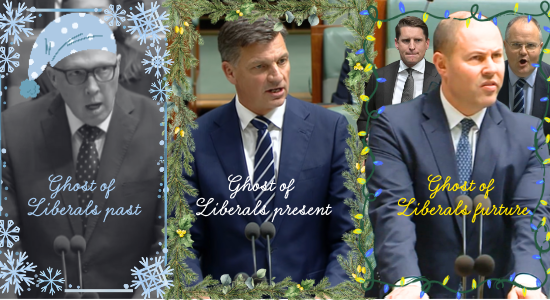
3. The ghosts of Liberal leaders
With Christmas just around the corner, Daniel Mulino shared some similarities that he had found in the opposition, ”With Christmas just around the corner, this reminds me of Charles Dickens's famous novel A Christmas Carol. Those opposite don't respect the classics, but let me go on. If those opposite had their way, this would be what Australians have to look forward to: a place where you work longer and harder and retire with less, a world in which the Liberals, the Nationals and One Nation play the role of Ebenezer Scrooge. We know how A Christmas Carol goes. This Christmas the Leader of the Opposition can expect a visit from the three ghosts of Liberal leaders.” The whole thing is absolutely worth the watch.
4. Own goal
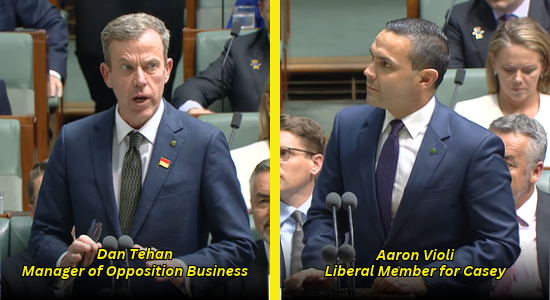
On Tuesday, Liberal frontbenchers Aaron Violi and Dan Tehan thought they had caught the PM out, accusing him of misleading the House when he said he'd never been asked about AI. Violi roared across the chamber, demanding the PM correct the record, claiming he had been asked about the issue on an earlier occasion. When I rose to point out that the question they were citing had actually been asked of a different minister, their argument quickly fell apart. They had demanded an apology for a misleading statement that had never been made. In other words, they misled the House by claiming there had been a misleading statement, and never apologised themselves.
5. Thank you for your rhetoric
This week, opposition questions have not been written with the Standing Orders or the Parliament in mind. They’ve transparently been 30-second rants designed for TikTok. On Tuesday, Liberal MP Mary Aldred asked a question that was so obviously aimed at social media that the PM couldn’t help but begin his response with, “I thank the Member for her rhetoric.”
While that’s all for Parliament this year, MPs will head back to their electorates to continue delivering for Australians. Both the House and the Senate will be back in February 2027.
’til then,
Tony
This week Australia lost an icon. Few Australians have done more to champion local music and shape our cultural life than Ian “Molly” Meldrum Song of the week is Russel Morris’ The Real Thing. Many Australians won't know that Molly produced the song in 1969 and it was written by Johnny Young.